
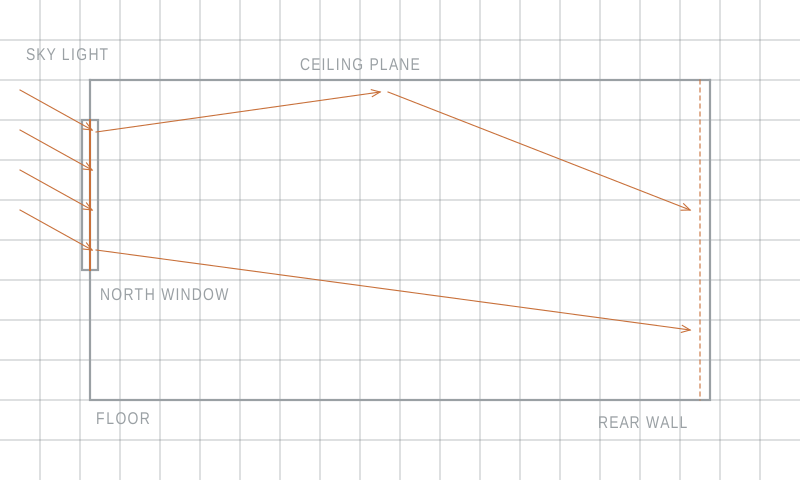
A room that faces north in the northern hemisphere never receives direct sun through its window. That single fact is responsible for most of what people dislike about such rooms, and for the one quality that makes them worth having. The light is constant. It does not swing from glare to gloom over the course of a morning, it does not throw hard shadows across a work surface, and it does not change colour dramatically between one hour and the next. Studios were traditionally given north light for exactly this reason.
What the room lacks is not light but brightness. Skylight is diffuse and comes from a large, dim source spread across the whole dome of the sky. Sunlight is concentrated and comes from a small, intensely bright source. A north window admits a great deal of the first and none of the second, so the room reads as even and slightly cool rather than dim in any absolute sense. Improving it is a question of collecting more of the sky and losing less of what arrives.
How much sky the window can see
The useful measure for a north room is not the area of the glass but the amount of open sky visible from inside it. Stand at the back of the room and look at the window. If what you see is mostly a neighbouring wall, a fence, a dense hedge or the underside of a deep overhang, the window is large but the sky it collects is small. Moving to the glass and looking up will usually show you where the sky has been cut off.
Two changes matter more than enlarging the opening. Raising the head of the window brings more of the upper sky into view, and the upper sky is considerably brighter than the band near the horizon. Cutting back or thinning whatever obstructs the view outside does the same thing from the other direction. A window taken up to the ceiling line will generally do more for a north room than the same area of glass added at sill level.
The reveal, meaning the thickness of wall around the opening, also plays a part. A deep reveal with square edges shades the glass and narrows the cone of sky the room can see. Splaying the reveal so the opening widens towards the room, or simply finishing it in a pale matt colour, recovers some of that loss without touching the structure.
Surfaces do the rest of the work
Once light is inside a north room, every surface it meets either passes it on or absorbs it. This is where most rooms lose the daylight they have. A ceiling is the single most valuable reflector in the room because skylight arrives on a downward slant and strikes it first. A white or near-white matt ceiling will keep bouncing that light towards the back of the room. A dark or strongly coloured ceiling will not.
The wall opposite the window is the second reflector. Keeping it light-toned pushes light back into the middle of the room, and keeping it matt rather than glossy spreads that light evenly instead of throwing a bright patch. Floors matter less than people expect, because the light reaching them has already crossed the room, but a very dark floor in a north room will noticeably deepen the whole space.
Colour behaves differently here than in a sunlit room. Skylight is weighted towards the blue end, so cool greys and blues can read as flat and slightly lifeless. Warm off-whites, soft ochres and warm greys counteract this without turning the room yellow. The effect is subtle but it is the difference between a room that feels calm and one that feels cold.
Where the room is used
North light rewards tasks that need consistency and punishes tasks that need cheerfulness. A desk, a drawing board, a sewing table or a kitchen worktop all benefit from light that does not move. A place to sit in the morning does not. It is usually better to arrange the room around what north light is good at than to fight the orientation with fittings.
Placing a work surface parallel to the window rather than facing it avoids working in your own shadow while keeping the even light on the task. Facing directly into a bright window puts a large dim source in your field of view and makes everything in front of it read as silhouette. Turning ninety degrees usually solves a room that felt unusable.
What not to expect
No amount of surface treatment turns a north room into a sunlit one. Mirrors opposite the window will add apparent depth and a second view of the sky, but they return only a fraction of the light and they return it as a bright rectangle rather than as general illumination. Light shelves, which work well with low-level sun, have little to do in a room that never receives it.
The honest conclusion is that the aspect sets the character and the work is in making that character good. A north room that is pale, high-windowed, matt-finished and arranged around a task is one of the pleasanter rooms in a house. The same room in dark paint with a small low window and a deep overhang outside is simply a dark room, and the orientation is only half the reason.