
Timber is a bundle of cells that were once carrying water. When it dries it shrinks, and when the air around it becomes humid again it takes water back and swells. This never stops. A hundred-year-old door is still moving with the seasons, just less than a new one, and every sound piece of traditional joinery is designed around that fact rather than against it.
The critical point is that the movement is not equal in all directions. Along the grain, timber moves so little it can be ignored. Across the grain it moves a great deal, and it moves differently depending on how the board was cut from the log. A wide board can change its width by several millimetres between a damp winter and a dry heated room, while its length stays effectively constant.
Moisture content and equilibrium
Timber does not dry to a fixed state; it comes into balance with the air around it. Wood stored in an unheated workshop reaches one moisture content, and the same wood installed in a centrally heated room reaches a lower one. The difference between those two states is the movement the joint will have to absorb, and it happens after the piece is made.
This is why timber is conditioned before it is worked, meaning it is stacked in the environment it will live in and left until it stops changing. Skipping that step transfers the whole of the shrinkage into the finished piece. It is also why a door fitted in a damp new building sticks all summer and then shows a gap at every joint once the heating has run for a season.
Quarter sawn and flat sawn
How a board is cut from the log changes how it moves. A flat sawn board, cut tangentially, has growth rings running roughly parallel to its face. It moves most in width and it tends to cup, curling away from the heart side as it dries. A quarter sawn board, cut radially, has rings running roughly perpendicular to the face. It moves about half as much in width and stays much flatter.
You can read this off the end grain without any special knowledge. Rings running across the end of the board in long flat arcs indicate flat sawn; rings running more or less straight from face to face indicate quarter sawn. Where flatness matters, as in a door stile or a table top, quarter sawn material is worth the extra cost and the narrower boards it comes in.
The framed panel as a solution
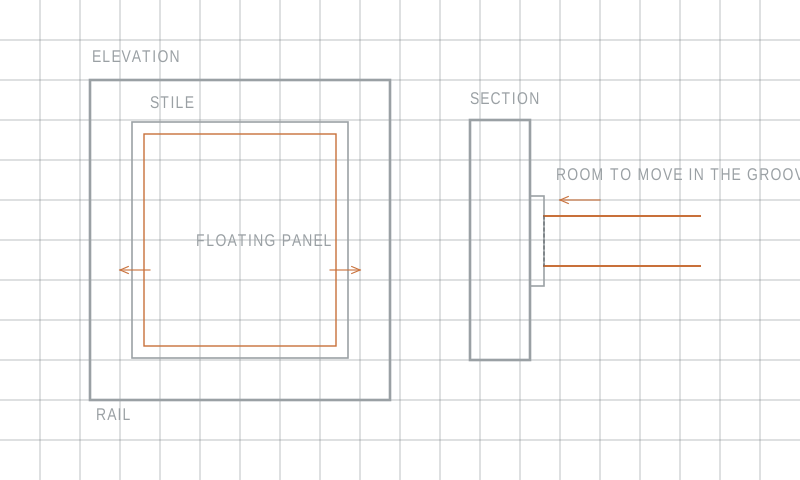
A wide flat expanse of solid timber cannot be fixed rigidly at its edges. It will either split as it shrinks or buckle as it swells. The frame and panel construction solves this with a frame of narrow members, whose length runs along the grain and therefore does not move, and a panel that sits loose in a groove in that frame.
The panel is never glued in and never pinned at more than one point. It floats. When the air is damp it grows into the depth of the groove; when it is dry it shrinks back, and the groove is cut deep enough that the panel edge never emerges. The frame holds the overall dimension stable while the panel does what timber does. This is why a four hundred year old panelled door still closes and a modern glued-up slab of the same species does not.
The same principle explains details that otherwise look arbitrary. A table top is attached with buttons or slotted plates rather than screws through a rail, so it can slide. A drawer bottom slides in a groove rather than being nailed all round. Breadboard ends on a table are pinned at the centre and slotted at the outside. In each case the joint lets one direction move and restrains the other.
Sheet materials and why they behave differently
Plywood, medium density fibreboard and particle board are engineered specifically to remove this problem. Plywood does it by crossing the grain of alternate layers so that each one restrains the next; the board moves very little in either direction in its plane. The fibre-based boards do it by having no grain direction at all.
That stability is why they appear as panels, as carcass sides and as substrates for veneer, and it is also why mixing them with solid timber requires thought. A solid timber edging glued along the full length of a sheet panel is fine, because both are moving along their stable direction. Solid timber applied across a sheet panel, or a sheet panel trapped in a solid frame with no allowance, reintroduces exactly the conflict the sheet was meant to avoid.
Working with it rather than against it
The practical rules fall out of the physics. Let the timber reach the humidity it will live in before working it. Read the end grain and orient boards deliberately. Keep solid components narrow where you can. Never fix a wide solid piece rigidly along both edges. Where a joint must cross the grain, give one side a slot. And finish all faces of a component equally, including the underside and the back, so that one face does not take up moisture faster than the other and cup the piece.