
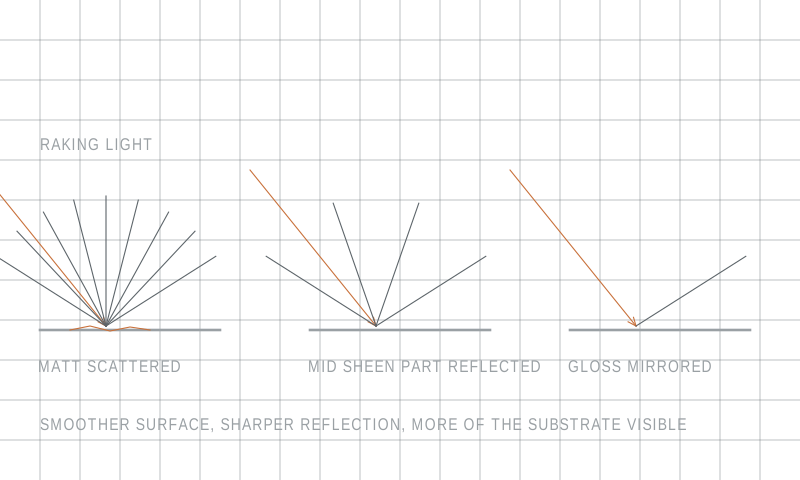
Sheen is usually presented as a matter of taste, or as a durability trade-off between wipeable gloss and fragile matt. Both of those are true and both miss the more important effect. Sheen controls how a surface reflects light, and therefore how much of the surface underneath it becomes visible.
A matt surface is microscopically rough. Light striking it scatters in every direction, so the surface looks the same brightness from every angle and no image of the light source appears in it. A gloss surface is smooth. Light striking it reflects predominantly in one direction, so from the right angle you see a bright image of the window or the lamp, and from the wrong angle you see very little.
Raking light and why walls look worse in the evening
When light arrives nearly parallel to a surface it is said to rake across it. Every bump casts a small shadow and every hollow catches a highlight, and the difference between the two is exaggerated enormously. A wall that looked flat under overhead light at midday can look like a relief map when a low sun comes through the window or when a lamp sits close to it.
This is the single most useful thing to know about inspecting a wall. Hold a light close to the surface and shine it along the wall rather than at it. Everything that has been filled, every joint, every ripple in the plaster and every sanding mark will appear. It is also why the worst place to put an uplighter is against a large flat wall, and why a wall lamp a few centimetres from the surface will show every flaw for the life of the building.
Sheen and flatness interact
Because gloss reflects directionally, a glossy wall reflects an image of the room, and any deviation in the surface distorts that image. The eye is very good at spotting a distorted reflection and much less good at spotting a shadow gradient. A high sheen finish therefore demands a genuinely flat substrate, and it will find any part that is not.
Matt does the opposite. By scattering light it removes the reflected image altogether and leaves only the shadows from raking light, which are far less conspicuous. This is why old, uneven plaster generally looks better in a matt finish and worse in anything approaching a sheen, and why a mid-sheen paint on a poorly prepared wall often looks worse than either extreme.
The practical consequence is that sheen should be chosen after looking at the wall, not before. A perfect new plaster surface can take any finish. A century-old wall with a history of repairs is asking for matt, and the amount of preparation needed to make it take a sheen is usually out of proportion to the benefit.
Where durability pulls the other way
The argument for sheen is that it is easier to clean and more resistant to abrasion, because the same smoothness that reflects light also gives dirt less to hold onto and gives the film more binder at the surface. That is why sheen has traditionally gone on woodwork, on kitchen and bathroom walls and at low level in corridors.
The resolution is usually to vary the sheen by what the surface does rather than by room. Large flat wall planes take matt. Woodwork, which is narrow, close to the eye and frequently touched, takes something with more sheen and gains a useful definition against the wall in the process. Ceilings take the flattest finish available, because they are lit at the most raking angle of any surface in the house and are almost never touched.
Colour and sheen are not independent
A colour appears deeper and more saturated in a higher sheen and lighter and chalkier in matt, because the matt surface is scattering some light back before it has been fully coloured by the pigment. The same paint colour can look like two different colours on a woodwork sample and a wall sample, which catches people out constantly when matching a new wall to existing joinery.
Dark colours show the effect most. A dark matt wall absorbs light thoroughly and reads as a soft, flat plane. The same dark colour in a sheen becomes a mirror for every light in the room and reads as much busier. Neither is wrong, but they are not interchangeable, and a dark colour chosen on a matt card and then applied in an eggshell will not be the wall that was expected.
Testing properly
Sample patches painted straight onto the wall are misleading, because the surrounding colour influences the eye and the patch edges create their own shadows. Painting two coats onto a large sheet of primed board and moving it around the room is a better test. Look at it against the window wall and against the wall opposite, in daylight and at night, and hold a lamp beside it at a raking angle to see what the sheen will do to the surface underneath.